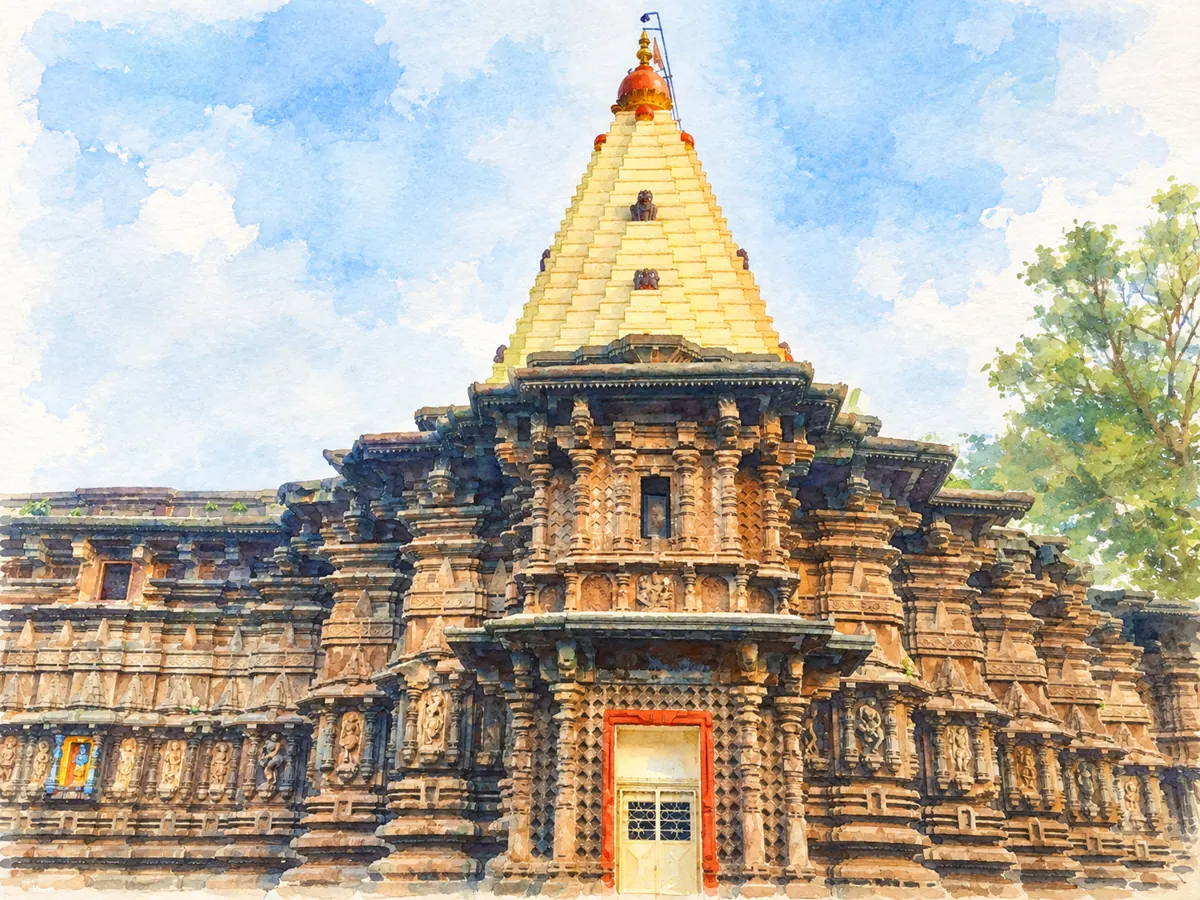
Watercolour of the Ambabai Temple shikhara and carved stone walls

Devi / Shakti · Kolhapur District, Maharashtra

Sri Mahalakshmi (Ambabai) Temple

Karveer Nivasini Ambabai Mandir

A west-facing Shakti Peetha where the setting sun reaches the Goddess twice a year.

Directions
Deity
Goddess Mahalakshmi, worshipped as Ambabai
Location
Kolhapur, Maharashtra
Best time
October to February, or Kiranotsav days
Nearest rail
Kolhapur Railway Station, about 2.5 km
Nearest airport
Kolhapur Airport (about 10 km, limited flights); Pune or Belagavi for wider connections
Help us complete this page.

Still to add: Photos.

Kshetram

About the temple

The Mahalakshmi Temple, known locally as Ambabai Mandir, stands in the heart of old Kolhapur, the ancient Karveer. The Ashtadasha Shakti Peetha Stotram, traditionally attributed to Adi Shankaracharya, names Karveer among the 18 Maha Shakti Peethas, and in Maharashtra it is one of the "three and a half" Shakti Peethas.

By custom, pilgrims visit Tirumala Venkateswara, Kolhapur Mahalakshmi and Padmavathi together as one yatra. The temple is managed by the Paschim Maharashtra Devasthan Samiti, and darshan is free for all.

Vishesham

What's unique about this temple

  • The Goddess faces west. Most Hindu temple deities face north or east. Ambabai faces west.
  • Kiranotsav, the sun's own darshan. A window in the western wall lets the setting sun fall straight onto the idol for three evenings, twice a year. The light reaches the feet, then the navel, then the whole body. The rays travel from the western Mahadwara through the Garuda Mandapa to the sanctum.
  • A rare standing form of Lakshmi. She stands about 3 feet tall with four arms, holding a matulinga (a large citrus fruit), a mace, a shield (khetaka) and a drinking bowl (panapatra).
  • Lion and Sheshnag. A stone lion stands behind her. Her crown carries Sheshnag and a Shivalinga encircled by a yoni under a cobra hood, bringing Vaishnava, Shaiva and Shakta symbols into one murti.
  • A gemstone idol. The murti is carved from a single gemstone and weighs about 40 kg.
  • Both bhukti and mukti. Kolhapur is held to be one of six places where a devotee may have desires fulfilled or be freed from them.
  • Completes the Tirupati yatra. Darshan of Sri Balaji is said to be incomplete without visiting Mahalakshmi here.
  • Daily visit of Dattatreya. Devotees believe Lord Dattatreya comes every noon to seek the Goddess's blessings.
  • History layered in stone. The octagonal Sheshashayi Vishnu shrine near the eastern gate carries a panel of 60 Jain Tirthankaras, and Jains once worshipped the Goddess as Padmalaya. In the Mughal period the idol was hidden for safety and reinstalled on Vijaya Dashami, 26 September 1712.

Sthala Purana

The legend

The Goddess slew the demon Kolhasura, which gives the city its name, and she remains its guardian deity.

Another legend tells that Lakshmi was angered when Vishnu did not respond to Sage Bhrigu's insult. She left Vaikuntha and did penance at Kolhapur, which is why a visit here completes the pilgrimage to Tirumala.

Moolavar

The deity

  • Goddess Mahalakshmi, worshipped as Ambabai (Mother) and Karveer Nivasini.
  • The temple has two storeys: Ambabai on the ground floor and the Matulinga on the first floor.
  • Subsidiary shrines include the Navagraha Mandir, Sheshashayi Vishnu and a Kalabhairava shrine, as at every Shakti Peetha. About 50 small shrines surround the main temple.

Itihasa

History

  • Built by the Chalukya king Karnadeva in 634 CE, in the Hemadpanthi stone style.
  • The shikhara was added in the 18th century by the Chhatrapati of Karveer state. The Garuda Mandapa dates from the late 18th century.
  • A Shri Yantra is carved on one of the temple walls.

Utsavam

Festivals

Jan–Feb
Kiranotsav (winter)

January 31 to February 2. The setting sun's rays enter through the western window and climb from the Goddess's feet to her whole body over three evenings.

Mar–Apr
Rathotsav

The chariot festival, in the month of Chaitra.

Sep–Oct
Navaratri

The biggest festival. The Goddess is adorned in a different form each day.

Oct–Nov
Diwali and Lakshmi Puja

Also Kojagiri Purnima and Lalita Panchami.

Nov
Kiranotsav (autumn)

November 9 to 11. The sun reaches the feet, then the navel, then the whole body.

Best time to visit: October to February, or Kiranotsav days. See every temple month by month in the yatra calendar.

Darshan

Darshan timings

Open5:00 AM – 10:00 PM

Aarti: Kakad 5:30 AM · Dhoop 6:30 PM · Main 8:00 PM · Shej 10:00 PM. Sources differ slightly on evening aarti times.

Yatra

Getting there

By air
Kolhapur Airport at Ujalaiwadi is about 10 km away with limited flights. Pune and Belagavi have wider connections.
By train
Kolhapur Railway Station is about 2.5 km away.
By road
Kolhapur Central Bus Stand is about 2.6 km away. The temple is on Mahadwar Road, Bhavani Mandap.

Before you go

Darshan
Free for all devotees. There is currently no VIP darshan pass.
Crowds
Lighter early in the morning and late evening on weekdays.

Of this place

Kolhapuri Saaj and Kolhapuri Chappal

Kolhapur is famous for the Kolhapuri Saaj, a traditional Maharashtrian gold necklace, and for hand-made leather Kolhapuri chappals.

Around here

Places nearby

About 2 km

Rankala Lake

A lakeside promenade popular at sunset.
About 3 km

New Palace Museum

Royal artefacts of the Kolhapur Chhatrapatis.

About 20 km, Wadi Ratnagiri

Jyotiba Temple

A hilltop temple to Jyotiba, deeply linked with Ambabai in local tradition.