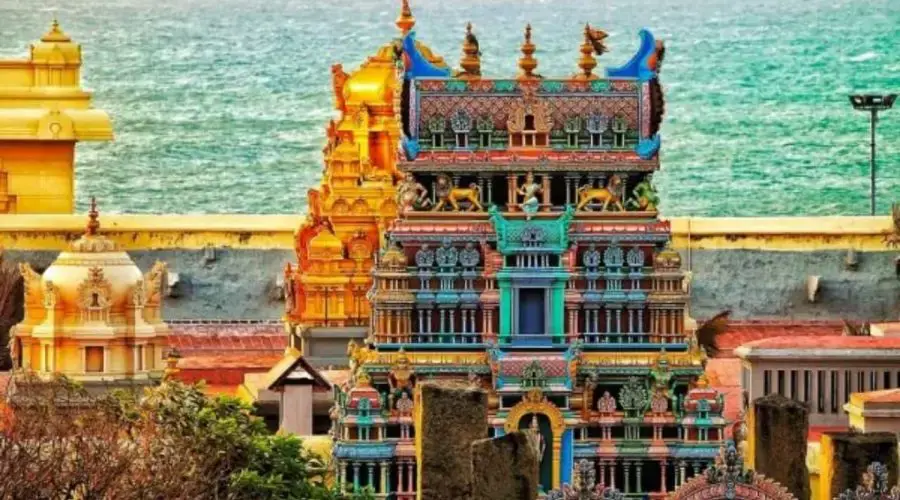
Kanyakumari temple towers against the sea

Devi / Shakti · Kanyakumari District, Tamil Nadu

Kanyakumari Bhagavathy Amman Temple

Kumari Amman Temple

The Virgin Goddess at Land's End, where the Arabian Sea, the Bay of Bengal and the Indian Ocean meet.

Directions
Deity
Devi Kanya Kumari (Bhagavathy Amman)
Location
Kanyakumari, Tamil Nadu
Best time
October to March
Nearest rail
Kanyakumari Railway Station, about 1 km
Nearest airport
Thiruvananthapuram International, about 90 km

Kshetram

About the temple

The Kanyakumari Temple, also called the Bhagavathy Amman Temple, is one of the most revered pilgrimage sites in South India. It stands on the seashore at the southern tip of mainland India, where three seas meet, and is dedicated to Goddess Kanya Kumari, the virgin form of Parvati.

A dip at the confluence of the three seas is considered holy. The Vivekananda Rock Memorial and the Thiruvalluvar Statue are a short boat ride away.

Vishesham

What's unique about this temple

  • Three seas, one shore. The temple stands where the Arabian Sea, the Bay of Bengal and the Indian Ocean meet. Pilgrims bathe at the confluence before darshan.
  • Sunset and moonrise together. It is the only place in India where, on a full-moon evening, you can watch the sun set and the moon rise from the same spot at almost the same time.
  • Sunrise all year, sunset in season. Sunrise over the sea is visible year-round. Sunset over the water is visible only from about October 15 to March 15.
  • The shining nose ring. The Goddess's diamond nose ring is said to have shone so brightly that sailors once mistook it for a lighthouse.
  • Sands from a wedding that never happened. The multi-coloured sands and rice-like pebbles on the shore are said to be the wedding feast, turned to sand when the marriage did not take place.

Sthala Purana

The legend

The Asuras once gained supremacy over the Devas. Banasura, king of the demons, drove the Devas from heaven and tormented saints and rishis. Mother Earth sought the help of Lord Vishnu, who advised the Devas to propitiate Parashakti, since only she could destroy Banasura.

The Devas performed a yagna. The Goddess appeared, promised to destroy the evil forces, and came to Kumari as a young virgin girl to do penance. Meanwhile Lord Shiva of nearby Suchindram fell in love with her, and a wedding was arranged for an auspicious hour at midnight.

Sage Narada knew Brahma had ordained that Banasura could be killed only by a virgin. As Shiva travelled from Suchindram and reached Vazhukkamparai, 5 km away, Narada took the form of a cock and crowed, falsely announcing dawn. Believing the hour had passed, Shiva returned home. The Goddess resolved to remain a virgin forever, and the food prepared for the wedding turned to sand.

Moolavar

The deity

  • The presiding deity is Devi Kanya Kumari, depicted as a youthful virgin goddess.
  • She holds a rosary in her right hand, a sign of meditation and penance.
  • Worshipped as a form of Shakti, she is believed to grant courage, prosperity and spiritual strength.

Itihasa

History

  • Believed to be over 3,000 years old, with references in the Ramayana, the Mahabharata and the Puranas.
  • Patronised by the Pandya, Chola and Nayak dynasties, each of which added to its architecture.

Utsavam

Festivals

Apr–May
Chaitra Purnima

A major full-moon festival with grand celebrations.

May–Jun
Vaisakha Festival

Ten days in the Tamil month of Vaikasi. The Goddess is taken in procession through the main streets morning and night. The car festival falls on the ninth day and the float festival on the last day.

Jul–Aug
Kalabham Festival

The idol is anointed with sandalwood paste.

Jul–Aug
Aadi Amavasai and Aadi Fridays

Auspicious days dedicated to the Goddess.

Sep–Oct
Navaratri

Commemorates the slaying of Banasura. The Goddess is taken in procession to Mahadanapuram, 4 km north, where the priests re-enact the battle in the Parivettai ritual.

Best time to visit: October to March. See every temple month by month in the yatra calendar.

Darshan

Darshan timings

Morning4:30 AM – 12:30 PM
Evening4:00 PM – 8:00 PM

Yatra

Getting there

By air
Thiruvananthapuram International Airport is about 90 km away and well connected to major Indian cities.
By train
Kanyakumari Railway Station is about 1 km from the temple, with trains from Chennai, Bengaluru, Thiruvananthapuram and other cities.
By road
Highways and regular buses connect it to Tamil Nadu and Kerala. Taxis and tour services are easy to find.
Locally
Auto-rickshaws and cycle-rickshaws cover the town.

Before you go

Dress code
Traditional attire preferred: dhoti or shirt for men, saree or salwar for women.
Photography
Not allowed inside the sanctum.

Around here

Places nearby

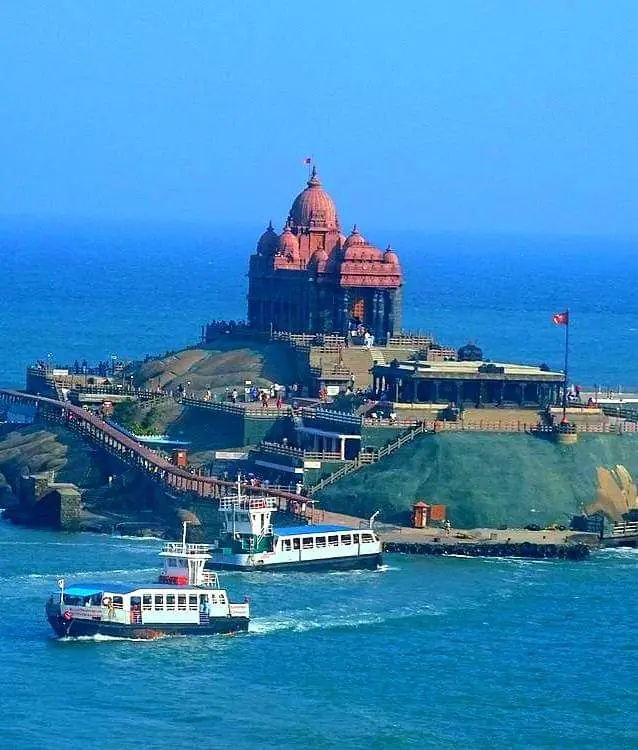
Vivekananda Rock Memorial
About 200 m offshore, by ferry

Vivekananda Rock Memorial

Swami Vivekananda meditated on this rock in 1892 before setting out for the West. The memorial opened in 1970. Its mandapam is modelled on the Sri Ramakrishna Temple at Belur, and its entrance on the Ajanta and Ellora cave temples.
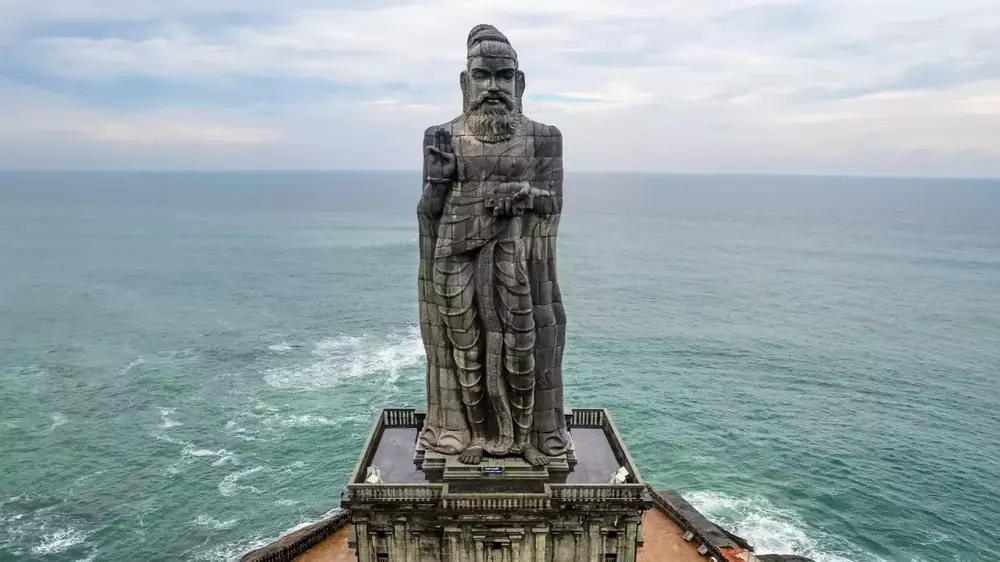
Thiruvalluvar Statue
Next to the Vivekananda Rock

Thiruvalluvar Statue

A 133-foot stone statue of the Tamil poet-saint Thiruvalluvar, author of the Thirukkural, on the neighbouring rock.

About 12 km

Suchindram Thanumalayan Temple

The home of Lord Shiva in the Kanyakumari legend, who set out from here for his wedding.

About 18 km

Nagaraja Temple, Nagercoil

Dedicated to the serpent deity Nagaraja. The prasad here is sand scooped from the ground where the deity is enshrined. The temple garden is known for its Naga flower (Couroupita guianensis).

About 32 km, on the Thiruvananthapuram road

Padmanabhapuram Palace

The old capital of Travancore, with a fort and a palace showing 17th and 18th century murals, woodwork and royal armoury. A temple stands near the palace.

About 90 km, towards Rameswaram

Tiruchendur Murugan Temple

A shore temple to Lord Subramanya and one of his six abodes, where he worships Shiva after defeating Surapadma.