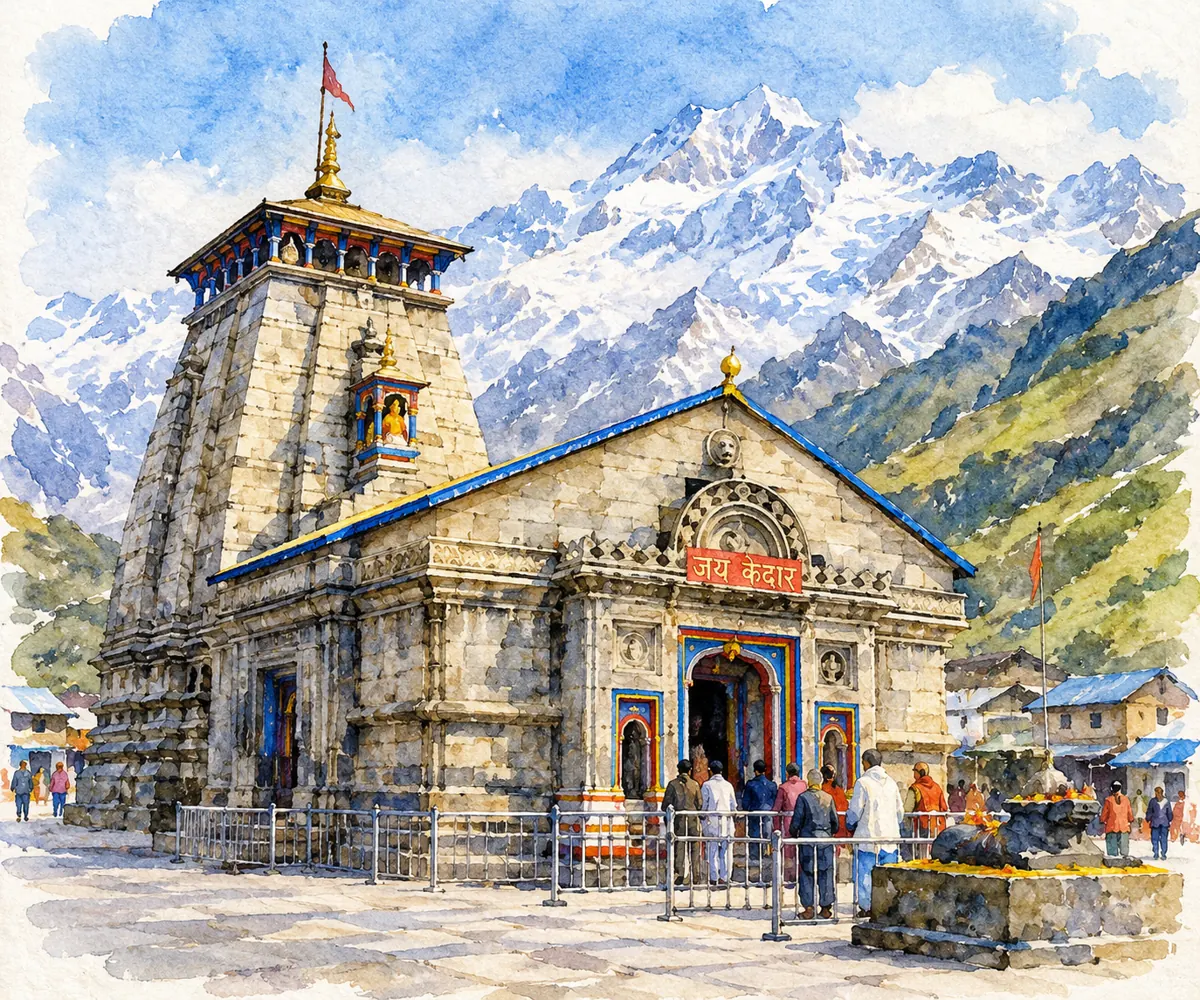
Watercolour of Kedarnath Temple with the Himalaya behind

Shiva · Rudraprayag District, Uttarakhand

Kedarnath Temple

The abode of Lord Shiva

The highest of the 12 Jyotirlingas, at 3,583 m in the Garhwal Himalaya.

Directions
Deity
Lord Shiva as a Jyotirlinga
Location
Kedarnath, Uttarakhand
Best time
May to June, September to October
Nearest rail
Rishikesh, about 216 km
Nearest airport
Jolly Grant Airport, Dehradun, about 238 km
Help us complete this page.

Still to add: Photos.

Kshetram

About the temple

Kedarnath, in the Himalayas of Uttarakhand, is one of the most sacred shrines of Lord Shiva. It is the highest of the 12 Jyotirlingas and part of the Char Dham Yatra. The temple stands at 3,583 m (11,755 ft) beside the Mandakini river, below Kedarnath peak (6,940 m).

It can be reached only on foot, by pony or palanquin, or by helicopter during the pilgrimage season.

Vishesham

What's unique about this temple

  • Highest Jyotirlinga. At 3,583 m, it is the highest of the twelve.
  • A triangular lingam. Shiva is worshipped as a hump-shaped, triangular Jyotirlinga.
  • Part of the Panch Kedar. The hump of Shiva in bull form remained here. Other parts appeared at the four other Panch Kedar temples.
  • Stood through the 2013 floods. The temple survived the devastating Uttarakhand floods, which devotees see as a divine sign.
  • Winter home. For six months the deity is worshipped at Ukhimath, and the main shrine is closed under snow.

Sthala Purana

The legend

After the Kurukshetra war, the Pandavas sought Lord Shiva's forgiveness for the bloodshed. Shiva avoided them and took the form of a bull. When they found him, he dived into the ground, leaving his hump at Kedarnath. Other parts of his body appeared at different places, which became the Panch Kedar temples.

Moolavar

The deity

  • Lord Shiva as the triangular Jyotirlinga in the garbhagriha.
  • The mandapa holds images of Parvati, the Pandavas, Nandi and Virabhadra.
  • Devotees believe the pilgrimage washes away sins and leads to moksha.

Itihasa

History

  • Origins are traced to the Mahabharata era.
  • The present temple is credited to Adi Shankaracharya in the 8th century CE.

Utsavam

Festivals

Feb–Mar
Maha Shivaratri

Night-long prayers. The temple is closed for winter, and worship continues at Ukhimath.

Apr–May
Opening ceremony

The doors open on Akshaya Tritiya with grand rituals.

Jun
Badri-Kedar Utsav

A cultural and spiritual festival linking Badrinath and Kedarnath.

Oct–Nov
Closing ceremony

Around Kartik Purnima the deity moves to Ukhimath for winter.

Best time to visit: May to June, September to October. See every temple month by month in the yatra calendar.

Darshan

Darshan timings

Morning4:00 AM – 3:00 PM
Evening5:00 PM – 9:00 PM

Seasonal shrine: opens in April/May on Akshaya Tritiya and closes in October/November around Kartik Purnima. In winter the deity is worshipped at Omkareshwar Temple, Ukhimath.

Yatra

Getting there

By air
Jolly Grant Airport, Dehradun (238 km). Taxis and buses run to Gaurikund.
By train
Rishikesh (216 km), connected to Haridwar and Dehradun.
By road
Roads reach Gaurikund. From there it is a 16 km trek, or ponies and palanquins.
By helicopter
Services from Phata, Guptkashi, Sitapur and Dehradun.

Before you go

Best experience
The early-morning Rudrabhishek puja, and sunrise over the Himalaya.
Stay
Guest houses, dharmashalas and GMVN lodges at Gaurikund, Guptkashi and Kedarnath.
Trek
About 16 km from Gaurikund, gradual but demanding.
Avoid
July–August monsoon, because of heavy rain and landslides.

Around here

Places nearby

Winter seat of Kedarnath

Omkareshwar Temple, Ukhimath

Where the deity is worshipped from November to April.